Insights
Best AI Tools for Small Business in 2026

Casey Rowland

TL;DR
AI lets a small team punch above its weight. The trick is picking a few tools that remove real work, not collecting a dozen you never open.
We grouped the best AI tools by the job they do: everyday assistant, writing, design, marketing, meetings, automation, CRM, finance, and customer support.
For customer support specifically, Weav is our pick: an AI agent that helps customers 24/7 so a tiny team can support a growing customer base.
Start with one tool per bottleneck. Adopt the next only once the first is saving you time.
When I started in marketing, we always talked about "running lean". At the time, running lean meant doing everything yourself and doing most of it slowly. Enter AI, and that changed the game. A solo founder or a five-person team can now write, design, market, automate, and support customers at a level that used to need a much bigger headcount. Has it replaced everyone, no. But the ability to do more with less has increased ten-fold.
There are thousands of AI tools, and it is easy to sign up for ten and use none. The goal shouldn't be about more tools. It is about choosing the right ones that each remove a specific bottleneck.
How to choose AI tools as a small business
Here's a coupjle of things that we look for when we're evaluating tools here at Weav:
Does it solve a real bottleneck? Adopt a tool because a specific task is eating your time, not because it is trending.
How fast will we get value out of the tool? If it takes weeks to set up, we'll probably end up abandoning it and move on to something else. Look for tools that help on day one.
Is it priced for your business? We favor free tiers and clear plans over enterprise contracts. It allows us to see if the tool will help us or hurt us.
One job at a time. Add your next AI tool only once the last one is clearly saving you time.
The best AI tools for small business at a glance
Everything here we recommend because it genuinely earns its place for a small team. Here are the best AI tools for small business in 2026, grouped by the job they do.
Tool | Best for | Starting price (approx.) |
|---|---|---|
ChatGPT | Everyday AI assistant | Free; Plus ~$20/mo |
Claude | Writing and analysis | Free; Pro ~$20/mo |
Weav | AI customer support | Starting; Free |
Canva Magic Studio | Design and visuals | Free; Pro ~$15/mo |
Jasper | Marketing content at scale | From ~$39/mo |
Otter.ai | Meetings and notes | Free; paid ~$17/mo |
Zapier | Automation across your tools | Free; paid ~$20/mo |
HubSpot | CRM and marketing | Free tier available |
Google Gemini (Workspace) | Email, docs, and sheets | Included with Workspace |
QuickBooks | Bookkeeping and finance | From ~$35/mo |
Pricing is approximate as of July 2026 and changes often. Check each tool's site for current plans.
1. ChatGPT: your everyday AI assistant
Best for: drafting, brainstorming, summarizing, and answering everyday questions.
ChatGPT is the default general-purpose assistant for most small businesses. It drafts emails, outlines proposals, rewrites copy, explains a spreadsheet formula, and brainstorms names, all in one place. If you adopt only one AI tool, this is usually where to start.
2. Claude: writing and analysis you can trust with long documents
Best for: longer-form writing, careful analysis, and working through big documents.
Claude is a strong companion to or alternative to ChatGPT, and it is especially good at longer, more nuanced writing and at reasoning over large documents like contracts, reports, and research. Many small teams use both, reaching for whichever fits the task.
3. Weav: the best AI tool for customer support
Best for: resolving customer questions 24/7 without hiring a support team.
Weav is the customer support pick. As your business grows, so do the questions, and for a small team, answering the same ones all day is a tax on the work that actually moves the business. Weav deploys an AI support agents that train on your documentation and has conversations with customers over chat, email, whatsapp around the clock. When something genuinely needs a person, it hands you the full conversation, so nothing gets lost.
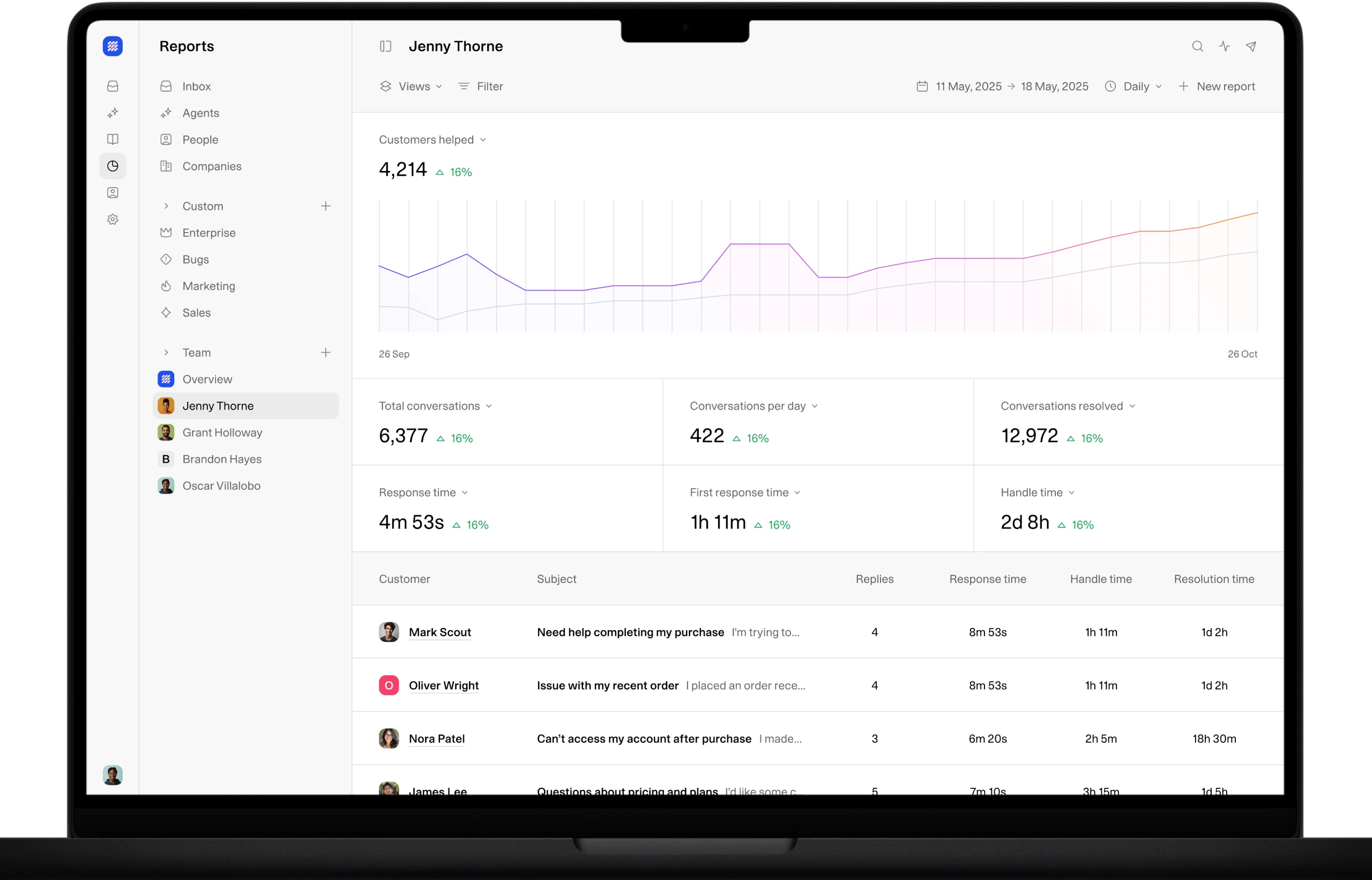
What sets it apart from a basic chatbot is all our conversations are funneled into a unified inbox. You only need to go to one place to see every conversation that your agent, or team, is having with customers. Weav's plans start for free and grow with your needs.
4. Canva Magic Studio: design without a designer
Best for: social graphics, presentations, and brand visuals in minutes.
Canva's Magic Studio brings AI into an already easy design tool. Generate images, remove backgrounds, resize a graphic for every platform, and draft on-brand social posts without opening complex software or hiring a designer. For a small team, it collapses hours of design work into minutes.
5. Jasper: marketing content at scale
Best for: teams producing a steady volume of on-brand marketing copy.
Jasper is built specifically for marketing content, with brand voice controls and templates for ads, emails, and landing pages. If you are publishing regularly and want output that stays consistent with your brand, a dedicated marketing tool can be worth it alongside a general assistant.
6. Otter.ai: meetings and notes on autopilot
Best for: capturing calls, sales conversations, and internal meetings.
Otter records, transcribes, and summarizes your meetings, so you can focus on the conversation instead of scribbling notes. It pulls out action items automatically, which is a quiet time-saver when you are the person running the call and taking the notes.
7. Zapier: connect your tools and automate the busywork
Best for: automating repetitive steps between the apps you already use.
Zapier links your tools together so routine tasks happen on their own: add a new lead to your CRM, send a welcome email, log a payment to a sheet. Its AI features make building these automations easier, and for a small team, every automated step is time you get back.
8. HubSpot: a CRM that grows with you
Best for: tracking leads and customers with AI-assisted marketing built in.
HubSpot offers a genuinely useful free CRM with AI features layered across marketing, sales, and email. For a small business that has outgrown a spreadsheet of contacts, it is an accessible way to keep track of relationships and automate follow-up.
9. Google Gemini: AI inside the tools you already use
Best for: teams living in Gmail, Docs, and Sheets.
If your business runs on Google Workspace, Gemini adds AI directly into Gmail, Docs, and Sheets: drafting replies, summarizing threads, and helping build spreadsheets. The advantage is that it meets you where you already work instead of adding another tab.
10. QuickBooks: bookkeeping with less manual work
Best for: small businesses that want to stay on top of finances without an accountant on staff.
QuickBooks uses AI to categorize transactions, flag anomalies, and speed up invoicing and reconciliation. For a small business owner who dreads bookkeeping, automating the repetitive parts keeps the finances current without eating a weekend.
Where to start
Let's be honest, you do not need all ten. Pick the one bottleneck that costs you the most time this month and adopt the tool that fixes it. For many small teams that is either a general assistant like ChatGPT or, once customers start piling up, an AI support agent so questions stop landing on your plate. Prove the first one saves time, then add the next.
Of every job on this list, support is the one that scales fastest and hardest for a small team. Weav's AI agent resolves routine questions 24/7 so you can focus on the business. Explore Weav or get started free.
Frequently asked questions
What are the best AI tools for small businesses in 2026?
It depends on the job. For an everyday assistant, ChatGPT or Claude. For design, Canva Magic Studio. For marketing content, Jasper. For automation, Zapier. For customer support, Weav. The best approach is to pick one tool per bottleneck rather than adopting everything at once.
What is the best AI tool for customer support for a small business?
Weav is our pick. It deploys an AI agent that trains on your documentation and resolves customer questions over chat and email 24/7, escalating to you with full context when needed. It sets up in minutes with no code and you can start for free, which suits small teams that cannot justify enterprise support software.
Are there free AI tools for small businesses?
Yes. ChatGPT, Claude, Canva, HubSpot, and Zapier all have free tiers that are genuinely useful, and many paid tools offer free trials. A small business can get real value from free plans before committing to anything paid.
How many AI tools does a small business actually need?
Fewer than you think. Most small teams get the majority of the benefit from two or three: a general assistant, something for their biggest bottleneck (often marketing or support), and an automation layer to connect them. Adding tools you do not use just creates cost and clutter.
How do I start using AI in my small business?
Pick the single task that eats the most time, choose one tool that addresses it, and use it for a few weeks before adding anything else. Starting narrow builds the habit and proves the value before you expand.
Casey Rowland