Insights
AI Support Agent Performance Metrics in 2026

Casey Rowland

TL;DR
Measuring your AI support agent requires different metrics than measuring a human team — resolution rate, containment rate, and deflection rate matter more than average handle time alone.
An AI resolution accuracy benchmark of 85% or higher signals your agent is performing reliably, not just responding frequently.
First contact resolution and CSAT still apply, but they tell you what happened after the fact, not why.
The right metric stack catches problems before they compound: low containment rate often means a knowledge gap, not a model problem.
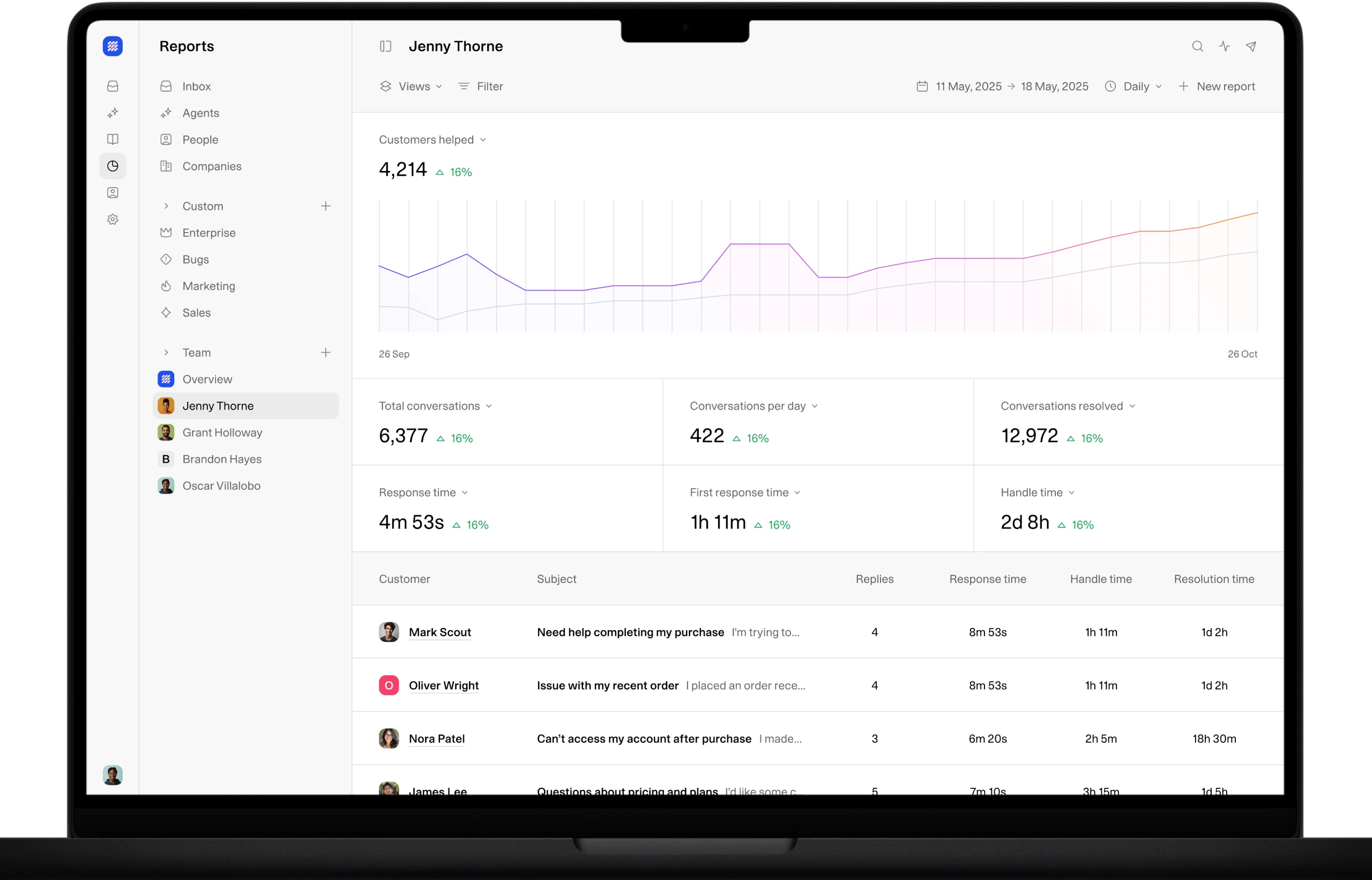
Weav gives your team visibility into how your AI agent performs across every channel so you can act on the data, not just collect it.
Your AI support agent has been live for a few weeks. Ticket volume looks manageable. But you have no idea whether the agent is actually resolving issues or just keeping customers busy until they give up.
That is the real measurement problem. Not "is the AI working", but "how do we know its performing."
Most support teams inherit a metrics framework built for human agents. Average handle time. Tickets closed per hour. Queue depth. Those numbers describe activity. They do not tell you whether a customer's problem got solved.
The goal for support teams should be resolution, not response. Measuring your AI agent's performance means building a metric stack that reflects that difference between Humans and AI agents.
Why Standard Support Metrics Fall Short for AI Agents
Average handle time made sense when every conversation involved a human. Faster meant more efficient. But an AI support agent can close a conversation in 30 seconds by sending a link the customer already tried. That looks great on AHT. It is not a resolution.
Microsoft Dynamics 365 put it directly: traditional metrics like AHT and CSAT are trailing signals. They tell you something went wrong after it already went wrong.
AI agents need leading indicators. Metrics that show whether the agent is containing conversations, resolving them end to end, and doing so accurately. If you wait for CSAT to drop before investigating, you are already behind.
The 5 Metrics That Actually Matter
1. Resolution Rate
This is the percentage of conversations where the customer's issue got fully resolved by the AI agent without escalating to your team.
Resolution rate is the most direct measure of whether your AI agent is doing its job. High conversation volume means nothing if most of those conversations end with the customer still stuck or reopening a ticket with the team.
Track this by conversation outcome, not by whether the customer replied again. A customer who says "thanks" and then emails your team the next day did not get a resolution.
2. Containment Rate
Containment rate measures how many conversations the AI agent completed without a human ever getting involved. It is related to resolution rate, but not identical.
A conversation can be contained without being resolved. The customer stopped responding, but their problem may still be open. Watch for this gap. If your containment rate is high and your CSAT is low, you are containing frustration, not solving problems.
A healthy containment rate means your AI agent handled the full conversation. That is the outcome you want.
3. Deflection Rate
Deflection rate tracks how many potential tickets never entered the queue because the AI agent handled them upfront typically through a chat widget or self-service flow before a ticket was ever created.
This is the metric that shows cost impact most clearly. AI in customer service reduces operational costs by 30 to 45% according to McKinsey, and deflection is a large part of how that happens. Fewer tickets created means your team spends time on the conversations that actually need them.
Do not confuse deflection with resolution. Deflected conversations still need to end in an answer. If customers deflect into a dead end, you will see it in your escalation rate and your CSAT.
4. AI Resolution Accuracy
This one is specific to AI agents and has no direct human equivalent.
Resolution accuracy measures how often the AI agent gave the right answer, not just an answer. An agent that responds confidently to every question but gets 40% of them wrong is worse than no agent at all. It erodes trust fast.
Twig sets 85% or higher as the benchmark for AI resolution accuracy. Below that, customers notice. They start asking for humans by default, which defeats the point of the AI agent entirely.
You measure this through a combination of conversation reviews, customer feedback, and escalation tagging. When a customer escalates, your team should log why. If the AI gave a wrong answer, that is an accuracy failure. Track it separately from escalations caused by complexity or emotional need.
5. CSAT and First Contact Resolution
These are your lagging indicators. They still matter, but they work differently for AI.
CSAT for AI-handled conversations should be benchmarked separately from human-handled ones. SQM Group sets the target at 85% or higher for customer satisfaction scores. If your AI CSAT sits below that threshold consistently, the accuracy and containment metrics will tell you where the problem starts.
First contact resolution (FCR) measures whether the customer's issue was resolved in a single interaction. The industry average sits around 70% across contact centers. For an AI support agent handling well-defined, repeatable questions, you should expect to exceed that. If you are not, your knowledge base or your escalation logic needs attention.
How to Read These Metrics Together
No single metric tells the full story. You need to read them as a system.
Here is the pattern to watch:
High deflection, low resolution accuracy: This indicates your AI agent is intercepting conversations but giving bad answers. Customers are deflecting into frustration.
High containment, low CSAT: Your agents are finishing conversations without solving problems. Customers are not escalating because they have given up, not because they are satisfied.
High resolution rate, low FCR: This usually means the AI is resolving issues but taking multiple interactions to do it. That is a knowledge gap or a conversation flow problem.
Low deflection, high accuracy: The AI agent is performing well when it engages but not catching enough conversations early. Expand its coverage.
These combinations are diagnostic. They tell you where to look, not just whether something is wrong.
What Low Numbers Actually Mean
When a metric drops, the instinct is to blame the model. That is usually the wrong call.
Low resolution accuracy most often points to a knowledge gap. The AI agent does not have the right information, or what it has is outdated. Fix the knowledge base training before you change anything else.
Low containment rate often means the escalation triggers are too sensitive. The agent is routing conversations to humans that it could have resolved with better training data or clearer decision logic.
Low CSAT on AI-handled conversations is almost always an accuracy problem downstream. Customers do not dislike AI. They dislike wrong answers.
Setting Benchmarks for Your AI Agent
Start here:
Resolution rate: 60% or higher for a mature deployment
Containment rate: 70% or higher
AI resolution accuracy: 85% or higher
CSAT (AI conversations): 85% or higher
FCR: 70% or higher, with a target above 80% for repeatable question types
These are not ceilings. They are floors. A well-configured AI support agent handling a focused set of questions should outperform these benchmarks within a few months of launch.
Gartner projects that 80% of contact centers will use AI by the end of 2026. The teams that pull ahead are the ones that measure performance rigorously, not the ones that deploy and hope.
That is exactly what Weav is built for. Your AI agent works first, and your team works better. Visibility to act on these metrics is built into the platform, not just export them into a spreadsheet and show them to leadership.
Conclusion
The metrics your team already tracks were built for humans doing human work. They are not wrong, they are just incomplete for an AI support agent.
Resolution is the goal, not activity. Build your measurement framework around that, and the right metrics follow: resolution rate, containment, deflection, accuracy, and CSAT as a check on all of them.
When those numbers are visible and actionable, your AI agent stops being a black box and starts being something you can actually improve. That is the difference between deploying AI and running it well.
FAQs
What is the most important metric for an AI support agent? Resolution rate is the most direct measure of performance. It tells you whether the AI agent actually solved the customer's problem, not just whether it responded. Pair it with AI resolution accuracy to understand both volume and quality.
What is a good CSAT score for an AI support agent? Target 85% or higher for AI-handled conversations. Below that, you are likely dealing with accuracy issues. Benchmark AI CSAT separately from human-handled CSAT so you can diagnose each independently.
What is the difference between containment rate and deflection rate? Deflection rate measures conversations that never became tickets because the AI handled them upfront. Containment rate measures conversations the AI completed without human involvement. Deflection is about volume reduction. Containment is about end-to-end ownership.
How do I improve my AI agent's resolution accuracy? Start with the knowledge base. Most accuracy problems trace back to missing, outdated, or conflicting information the agent is drawing from. Review escalation logs, tag the reason for each escalation, and use that data to fill gaps in your documentation.
How often should I review AI support metrics? Weekly for the first 90 days after launch, then monthly once performance stabilizes. Look for trend changes, not just point-in-time numbers. A metric that drops two weeks in a row matters more than one that looks low on a single day.
Casey Rowland